

The 1927 Solvay Conference on Physics is one of the three most important conferences prior to WWII along with those of 1911 and 1933. This represented the apex of a lengthy debate about the philosophical implications of quantum mechanics. However, the discovery of quantum mechanics helped to revolutionise our understanding of particle physics. This laid the groundwork for studying the structure of matter at such particulate levels and probes that we previously could not undertake or comprehend. The evolution that followed from the innovative ideas of the seminal discovery were a complete restructuring of the discipline of classical mechanics. This became a cornerstone of cross-disciplinary thinking and research that included a modern notion of how matter behaves and interacts, as well as profound implications for old questions about the possibility of gravity, blackholes and the nature of time. Quantum computing, modern technologies that are very beneficial, rely on quantum mechanics. In this article we will delve into the insights about quantum computing and their potential applications and limitations.
What is Quantum Computing?
Quantum Computers are game-changers. Quantum computing is a new computational paradigm that utilises quantum computers built by applying principles of quantum mechanics. They out-perform classical computers on computation problems that are intractable on traditional computers, and can reduce computational time by orders of magnitudes. Quantum Computers are optimal at searching databases, factoring primes, finding optimal solutions, as well as some machine learning problems. As such, QC promise to speed up the process of solving problems intractable on today's computers.
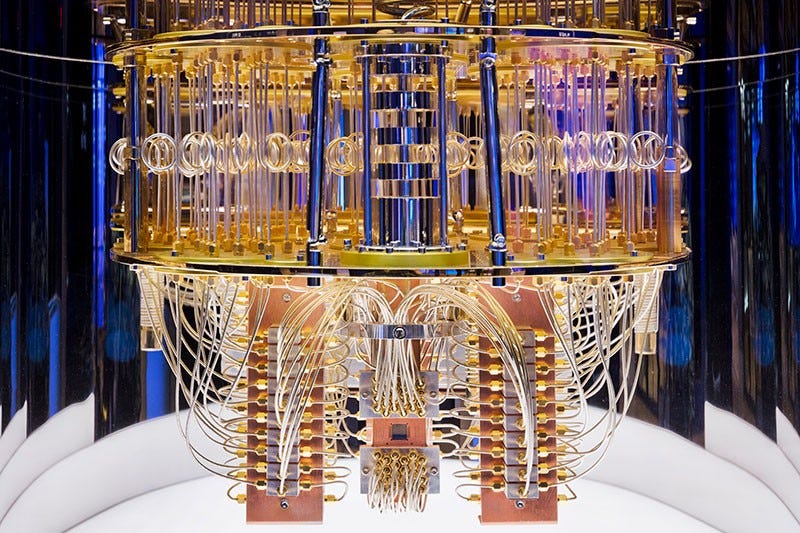
How does it work?
Quanta are known as quantum bits, and operate with states that can be both 0 and 1, rather than with classical bits with 0 or 1 values. The classical computer limits storage capacity, whereas the quantum can store an unlimited amount of information. This makes the quantum computer especially powerful. However, quantum computers use qubits, as opposed to classical bits, or the bits used in classical computers. A standard classical bit can represent values as either zero or one, but a quantum bit, or qubit, symbolizes both zero and one at the same time and somewhere in the mixture of the two. In order to illustrate this, take a coin and toss it; results can either be heads or tails. But if you spin the coin, it doesn’t have just an equal chance of landing on either, but could also land anywhere in between. Sometimes it lands folded, double-sided. The coin is in a state of superposition, where it is both heads and tails, and somewhere in between. Superposition is one of the intrinsic features that make quantum computers powerful. The other feature is called entanglement. When two coins are tossed, the outcome of coin one toss does not influence the outcome of coin two. They’re autonomous. Quantum entanglement states that two particles are connected and affect one another even if those particles are light-years apart. If one comes up heads, the other one will also be headed. In quantum computing, this implies we can disseminate information even if it contains uncertainty. We can take that spinning coin and use it to perform complex calculations. And if we can string together multiple qubits, we can tackle problems that would take our best computers millions of years to solve. Quantum computers are not improved classical computers but are like what a bulb is to a candle. These computational devices are fundamentally different in both construction, more significantly, in the way it processes information.
Some applications of Quantum Computing
Quantum computers are extremely complex computing machines that allow us to not only accomplish the things we do today, but to solve difficult problems quickly. By interpreting the intricacies of qubits, we can accelerate AI research greatly. Bringing to bear the superior capacities of AI advancements. Google is already using them to improve the software of self-driving cars and the ever growing capabilities in modelling chemical reactions. In finance quantum computing will allow for simulations to predict the variables that drive market statistics such as risk and uncertainty. Discovering new patterns and flaws in enterprise challenges much faster. Encryption, a quantum computer running Shor’s algorithm will be able to decipher the most common encryption methods in a matter of days, if not hours, a classical computer would take thousands of years to do the same task. This is a huge deal, and today's manufacturers do not produce quantum technologies that are capable of being used in cryptography technology.
Drawbacks of Quantum Computing
Numerous challenges exist in constructing a large-scale quantum computer - fabrication, verification, and architecture. The strength of quantum registering lies in its capability to store a complex state in a single bit. This likewise makes quantum frameworks challenging to construct, ascertain, and design.
Although QC research has matured, it has mostly concentrated on the development of technical elements such as software, quantum technology and hardware. Likened to the technical aspects, research efforts to recognise challenges and opportunities for extending QC knowledge remain limited. For example, researchers do not comprehend the possible applications of QC in various industries for project management, quality improvement, and supply management. Important for studies going into the future because quality control programs in areas such as health, finances and energy will increase the efficiency and efficiency of business processes. As an example, quantum technologies (QT) can be utilised to create new drugs or materials or to improve production processes. Therefore, it is necessary to study the main problems that quality management programs face.
Quantum Computing scope
Quantum computing is based on theory, but cruising fast toward real impact. QC can help solve problems that industry has never tried to solve before. Quantum computing can lead to significant advances in several spheres including economics, healthcare, pharmaceuticals, finance, manufacturing, logistics and energy production. The era of quantum computing is just beginning, through this blog I look forward to bringing it to a wider audience. ~Xolani Ndlovu
https://www.space.com/31933-quantum-entanglement-action-at-a-distance.html
https://www.sciencedirect.com/science/article/pii/S0950584922000581#bib0001
https://qiskit.org/documentation/qc_intro.html
https://www.supertrends.com/quantum-computing-in-banking-and-finance-threat-or-opportunity/
https://explore.psl.eu/en/discover/focus/introduction-solvay-conferences-physics
https://www.senetas.com/the-impact-of-quantum-computing-on-cryptography
~Xolani Ndlovu Research Scientist @XenoGenAi Labs